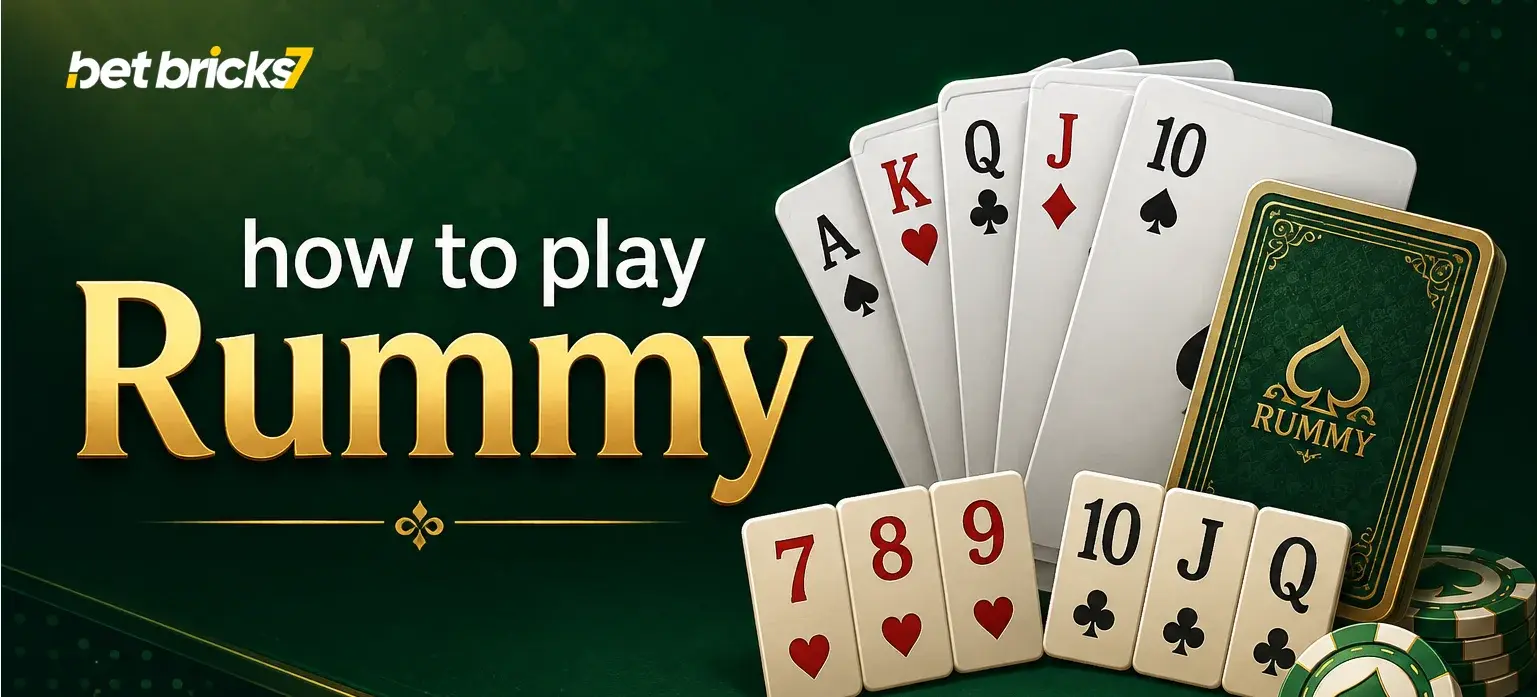
Rummy is a matching card game where players draw and discard cards to form sets (same rank) and sequences (consecutive cards of the same suit). The objective is to be the first player to arrange all cards into valid combinations and empty your hand.
The game works especially well with three or more players, although two people can also play. Rummy also has plenty of variations, so the rules can change slightly from one version to another. This guide covers the basic form of Rummy, including the deal, melds, drawing, discarding, laying off, going out, and scoring.
What Is Rummy?
Rummy is a matching card game in which players try to organize cards in their hands into sets and sequences. A set contains three or four cards of the same rank. For example, three 8s from different suits make a valid set.
A sequence contains three or more cards of the same suit in consecutive order. A run such as 7, 8, 9 of hearts is a valid sequence. The aim is to form these combinations and eventually get rid of every card in your hand.
Rummy works particularly well when several people sit at the same table. The larger player count adds more uncertainty because you have more cards moving through the discard pile and more players trying to collect useful combinations.
| Set | Sequence |
| Same rank | Same suit |
| Different suits allowed | Same suit required |
| 3–4 cards | 3+ consecutive cards |
Rummy Card Rankings
In most versions, cards rank from Ace through King. Some variations allow the Ace to be used as either the lowest card (A-2-3) or the highest card (Q-K-A).
In many Rummy variations, the ace can work as either a high or low card. The exact treatment of the ace depends on the version you are playing, so it helps to confirm the house rules before the first deal. For scoring purposes, however, aces count as 1 point in the basic version covered here.
How the Cards Are Dealt
The dealer gives one card at a time, face down, starting with the player on the dealer’s left. The number of cards each player receives depends on how many people are playing:
| Number of Players | Cards Per Player |
| 2 players | 10 cards |
| 3 players | 7 cards |
| 4 players | 7 cards |
| 5 players | 6 cards |
| 6 players | 6 cards |
After dealing, the remaining cards form the stock. The dealer places the cards face down in the middle of the table.
The dealer then turns the top card face up and places it beside the stock. This card starts the discard pile. When two people play, the winner of the hand deals the next one. With more than two players, the deal moves to the next player on the left.
How a Rummy Turn Works
The player to the dealer’s left takes the first turn. Every turn follows the same basic pattern.
First, the player draws one card. They can choose either the top card from the stock or the top card from the discard pile.
After drawing, the player can place a valid meld face up on the table. A meld can contain a set or sequence that meets the game’s requirements. The player then finishes the turn by discarding one card face up onto the discard pile.
There is one important restriction to remember. When you take the top card from the discard pile, you cannot discard that same card during the same turn. This draw-and-discard cycle continues around the table until someone gets rid of every card.
Understanding Sets and Sequences
The main skill in Rummy involves recognizing cards that work together.
Sets
A set contains three or four cards with the same rank.
For example:
5♠, 5♥, 5♦
These cards form a set because they all have the same rank.
You can also form a four-card set by adding the fourth suit:
5♠, 5♥, 5♦, 5♣
The suits do not need to match in a set. The rank does.
Sequences
A sequence uses cards of the same suit in consecutive order.
For example:
8♣, 9♣, 10♣
This forms a valid sequence because the cards follow one another and all belong to clubs. You can continue a sequence with additional cards when the order remains correct. For example, if 8♣, 9♣, 10♣ is already on the table, another player can add J♣ to the sequence.
What Does Laying Off Mean?
Laying off gives players another way to reduce the cards in their hands. Once a player has placed a matched set or sequence on the table, other players can add suitable cards to those combinations during their turns.
Suppose someone has placed three 3s on the table. If you hold the fourth 3, you can add it to that set. The same idea applies to sequences. If the table shows 10♥, 9♥, 8♥, you can add J♥ to continue the sequence.
You can also extend the other end when the cards fit. For example, 7♥ can follow the existing sequence on the lower side. Laying off can help you remove difficult cards from your hand without waiting to build a completely new meld.
How Do You Go Out in Rummy?
Going out means getting rid of every card in your hand. A player normally ends their turn by discarding. However, a player can also finish the hand without a discard when all of their remaining cards form valid melds.
For example, suppose you hold cards that can all form complete sets and sequences. You can lay down those cards on your final turn and end the hand. Once a player gets rid of all their cards, that player wins the hand, and the other players stop playing.
What Happens When the Stock Runs Out?
Sometimes nobody goes out before players use every card in the stock. When the final stock card gets drawn, the next player has two choices. They can take the top card from the discard pile, or they can turn the discard pile over to create a new stock. The new stock does not get shuffled. Play then continues normally.
How Rummy Scoring Works
Rummy scoring focuses on the cards left in each player’s hand when another player goes out.
Each losing player pays the winner the value of the cards remaining in their hand. Cards that already form matched sets still count if they remain in the player’s hand rather than on the table.
The basic card values are:
| Card | Point Value |
| Ace | 1 |
| 2 through 10 | Face value |
| Jack | 10 |
| Queen | 10 |
| King | 10 |
For example, a hand containing an ace, a 7, and a king would carry 18 points.
What Is Going Rummy?
A player goes “rummy” when they get rid of their entire hand at once without previously putting down or laying off any cards.
This earns a special scoring bonus. Some Draw Rummy variations award a bonus when a player goes out without previously melding any cards. Going Rummy can therefore produce a much larger score than winning through ordinary play.
Simple Rummy Tips for Beginners
You do not need a complicated system to start playing. Pay attention to the cards you draw and the cards other players discard.
Keep these points in mind:
- Watch the discard pile before taking a card.
- Look for sets and sequences as you build your hand.
- Avoid holding high-value cards for too long when they do not help your combinations.
- Pay attention to cards that other players appear to collect.
- Keep your useful combinations organized so you can make decisions quickly.
The discard pile can also give you clues about what other players need. If someone repeatedly avoids a particular suit or rank, that information can help you decide what to keep and what to throw away.
Experienced players pay close attention to which ranks opponents repeatedly pick up or ignore, as this can reveal the combinations they are building.
Start Playing Rummy
Rummy has a straightforward foundation: draw a card, build sets or sequences, discard one card, and try to empty your hand before everyone else. Once you understand how melds work, the rest of the game falls into place quickly.
Grab a deck, get a few players around the table, and give a round of Rummy a try. Keep your cards organized, watch the discard pile, and think carefully about every draw and discard. Play Rummy at Betbricks7 today! See how quickly you can turn a handful of cards into a winning hand.
Frequently Asked Questions
How many cards does each player get in Rummy?
Two players receive 10 cards each. Three or four players receive seven cards each, while five or six players receive six cards each.
What is a valid set in Rummy?
A valid set contains three or four cards of the same rank. The cards can come from different suits.
What is a sequence in Rummy?
A sequence contains at least three consecutive cards from the same suit. For example, 6, 7, and 8 of hearts form a sequence.
Can I take the top card from the discard pile?
Yes. You can take the top card from the discard pile instead of drawing from the stock. However, you cannot discard that same card during the turn.
What happens when someone goes out?
The hand ends as soon as a player gets rid of all their cards. The remaining players then calculate the value of the cards still in their hands and pay that amount to the winner.